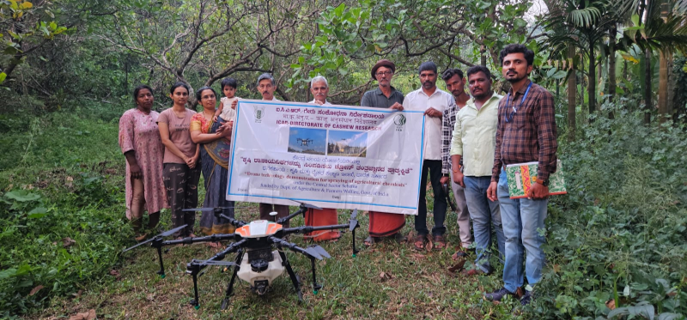
Cashew is one of India’s most important commercial horticultural crops, contributing significantly to farmers’ livelihoods, employment generation and agricultural exports. However, managing pests and diseases in cashew plantations through conventional spraying methods remains a major challenge due to tall trees, dense canopies, uneven terrain, labour shortages and increasing cultivation costs.
Agricultural spraying drones are emerging as an innovative solution to these challenges, enabling farmers to protect their cashew plantations with greater efficiency, precision and safety.
Traditional spraying methods using knapsack sprayers, power sprayers and manual labour present several limitations:
- Difficulty in reaching the upper canopy of cashew trees.
- Uneven distribution of pesticides and foliar nutrients.
- Excessive consumption of water and agricultural inputs.
- High dependency on skilled agricultural labour.
- Direct exposure of operators to harmful chemicals.
- Difficulty in spraying plantations located on hilly and uneven terrain.
- Time-consuming spraying operations across large plantations.
At Multiplex Drone Pvt Ltd, we are transforming cashew cultivation
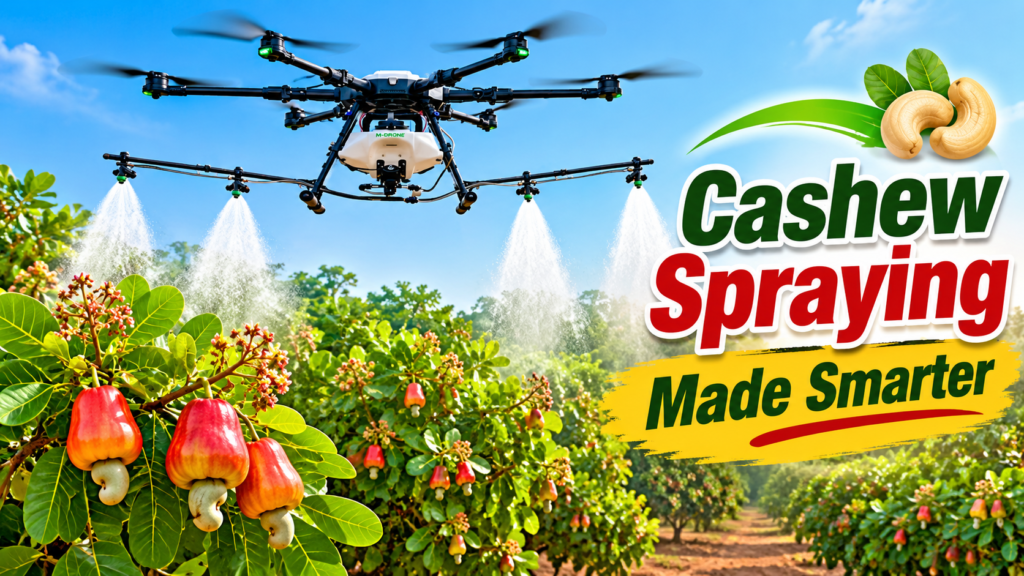
MD-10H Series Agricultural spraying drones are equipped with advanced flight controllers, GPS-based navigation, terrain-following sensors and precision spraying systems. These technologies enable drones to fly above cashew trees and deliver agricultural inputs in a controlled manner.
The downward airflow generated by drone propellers assists in the movement of spray droplets into the tree canopy, helping improve coverage when appropriate flight parameters are maintained.
Drone technology allows farmers to complete spraying operations in significantly less time without requiring workers to physically access tall trees or difficult terrain.