
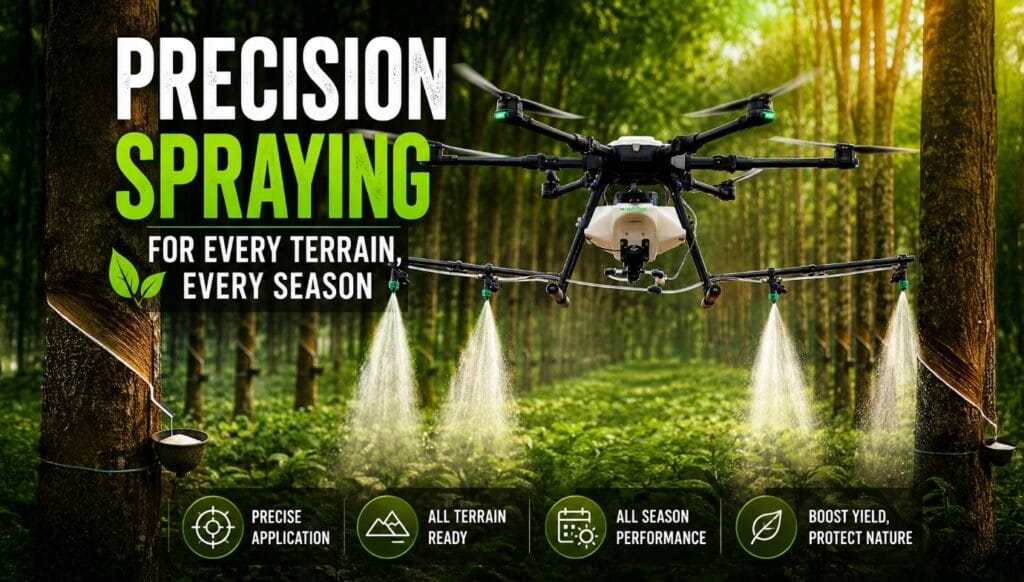
Rubber cultivation is one of the most important plantation crops in India, particularly in states such as Kerala, Karnataka, Tamil Nadu, and the North-Eastern region. Maintaining healthy rubber trees requires timely application of fungicides, insecticides, micronutrients, and growth-promoting solutions. However, traditional spraying methods often struggle to meet these requirements due to the height of the trees, uneven terrain, and changing weather conditions.
Agricultural drones are revolutionizing rubber plantation management by offering a faster, safer, and more effective alternative to conventional spraying methods.
Major Benefits for Rubber Plantation Owners
Better Disease Management
Rubber plantations are susceptible to several fungal diseases that require timely and uniform spraying.
Drone spraying enables rapid response before diseases spread across large plantation areas.
Improved Pest Control
Consistent droplet distribution helps improve control of insect pests by ensuring more uniform coverage across the canopy.
Lower Labour Dependency
One trained drone operator can accomplish work that would otherwise require multiple labourers, helping plantation owners manage labour shortages more effectively.
Reduced Operational Costs
Although drone spraying involves advanced technology, it can reduce overall operational expenses by lowering labour requirements, minimizing chemical wastage, and completing spraying more quickly.
Increased Productivity
Timely and effective spraying helps maintain healthier trees, reduces stress caused by pests and diseases, and supports consistent latex production.
Advantages of using Multiplex Drone (MD-10H) during Monsoon
One of the biggest advantages of drone spraying in rubber plantations is its ability to make use of short weather windows.
During the monsoon:
- Manual workers often cannot enter slippery plantations safely.
- Wet ground makes transporting equipment difficult.
- Delayed spraying allows pests and diseases to spread rapidly.
Drones can be deployed quickly during short breaks between rainfall, allowing plantation owners to complete spraying before the next rain. This flexibility helps maintain effective crop protection even during challenging weather conditions.
YouTube Video: https://youtu.be/-9FUtA3Lw5Y?si=BZOc-ptsUy__kT2C